
Vacuum Insulated Pipe vs. Foam-Insulated Pipe vs. Bare Copper
Choosing the right insulation for cryogenic liquid transfer has a direct, compounding impact on product loss, safety, and total cost of ownership — and the gap between options widens every year a system stays in service.
Three ways to move cryogenic liquid — and three very different cost profiles
This page compares the three most common methods used to transfer liquid nitrogen, liquid oxygen, liquid argon, LCO₂, and LNG: bare (uninsulated) copper or stainless pipe and uninsulated transfer hoses, conventional foam/mechanically insulated pipe, and Vacuum Insulated Pipe (VIP). Foam-insulated pipe remains a sound, cost-effective choice for short runs, budget-driven projects, and temporary or short-duration installations. For permanent runs, longer distances, or any application where product loss, safety, or long-term reliability matters, VIP is the standard.
Mechanically Insulated Pipe
A carrier pipe encased in closed-cell foam. Straight runs are factory-made; the joints — elbows, tees, field unions — are field-installed and are exactly where foam systems are most vulnerable to bond gaps, moisture, and ice over time.
CryoCraft VIP
An inner carrier pipe inside an evacuated, MLI-packed outer jacket. Heat leak is dramatically lower than either alternative and stays low for the life of the system — it doesn’t degrade with age or weather.
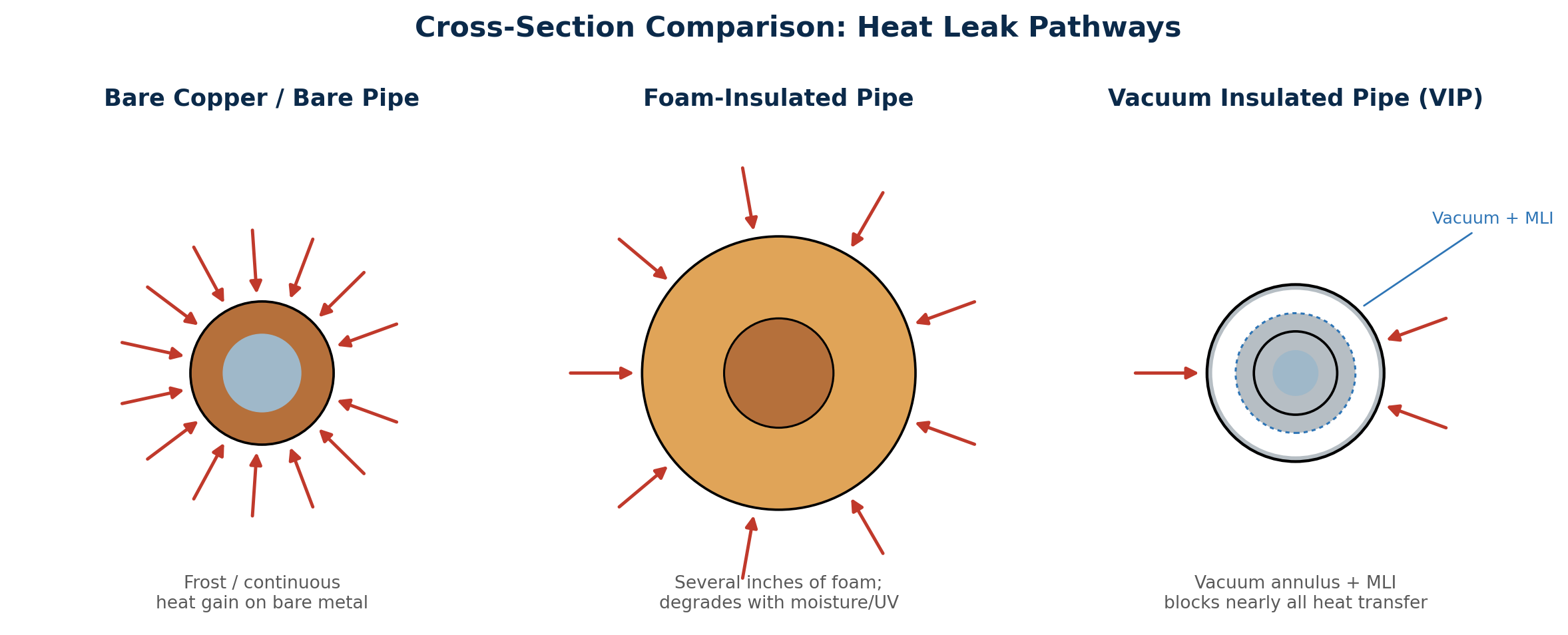
How the three technologies stack up
| Attribute | Bare Copper | Foam-Insulated Pipe | Vacuum Insulated Pipe |
|---|---|---|---|
| Relative thermal performance | Baseline (highest heat leak) | ~4–6x better than bare pipe | ~200x better than bare; ~50x better than foam |
| Typical LN₂ loss over distance | Severe — not practical beyond a few feet | Moderate — compounds over long runs | Minimal — enables long-distance transfer |
| Service life / degradation | Indefinite, but heat leak never improves | 5–10 yrs typical — heat leak compounds with age (often +100–150% within ~10 yrs) | 10–30+ yrs — performance holds steady |
| Moisture / weather resistance | N/A — frosts/ices continuously | Poor — degrades and can fatigue/crack brazed joints over time | Excellent — sealed jacket, unaffected by weather |
| Installation | Simple, fast | Field fabrication + insulation application; labor-intensive | Pre-engineered straight sticks/bayonets; fast, repeatable |
| Relative first cost (installed) | Lowest | Low–Moderate | Higher upfront, lowest lifecycle cost |
| Best-fit applications | Very short jumpers, non-critical, low-value gas | Short runs, budget-constrained, temporary/short-duration setups | Any run where loss, safety, distance, or reliability matters; long-term installations |
Figures are representative industry guidelines and will vary by line size, insulation thickness, MLI quality, and installation conditions. CryoCraft Systems can provide a project-specific heat leak calculation on request.
Foam doesn’t stay at day-one performance
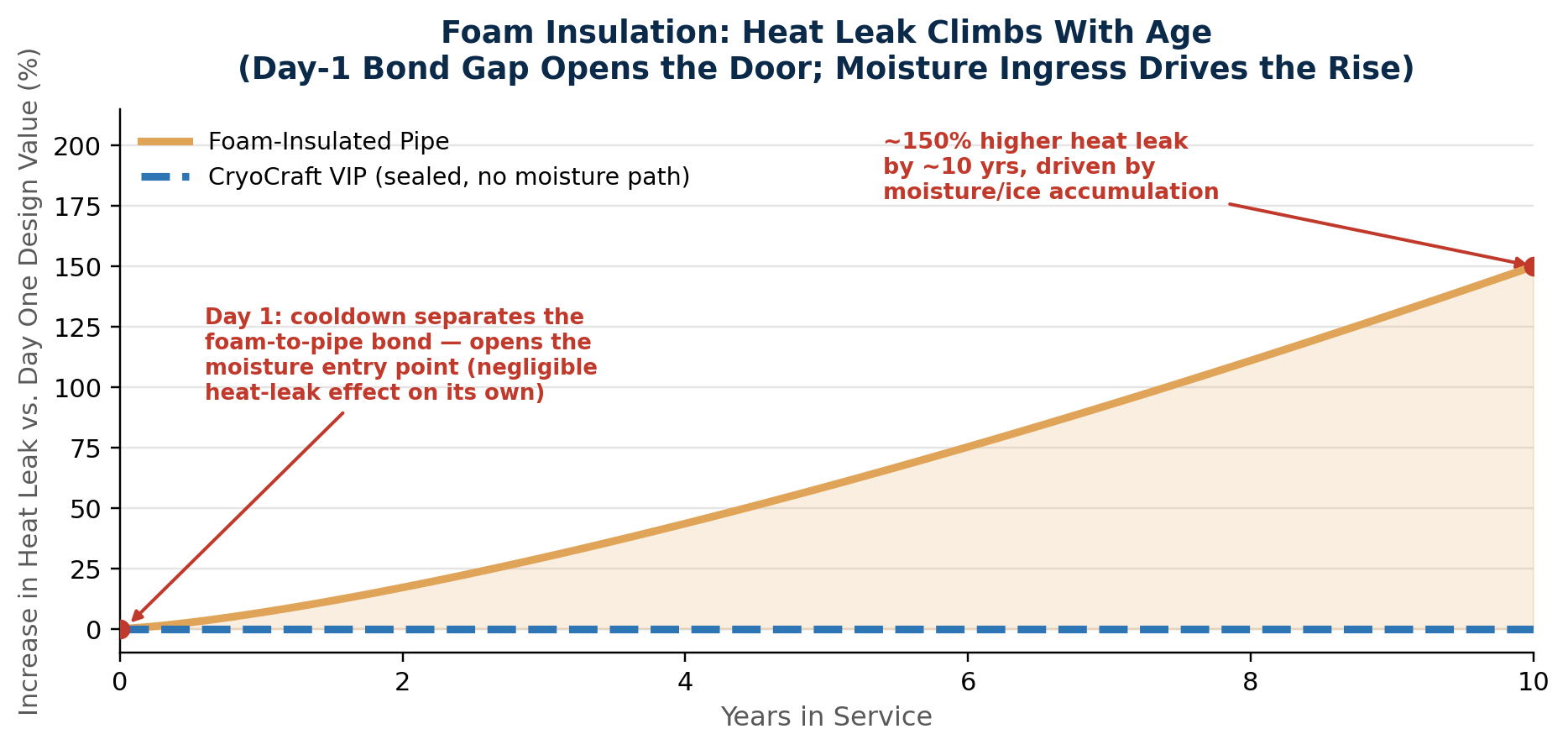
Copper contracts slightly as it cools, separating the foam-to-pipe bond from the very first cooldown — opening the door for atmospheric moisture to migrate in and freeze. From there:
- Ice occupies the cells that used to hold insulating gas, and frozen water conducts heat far better than the foam it replaces.
- Cracked cells let in more moisture on every subsequent freeze/thaw cycle, compounding the problem.
- Published accelerated-aging data shows closed-cell foam’s thermal conductivity rising on the order of 100–150% after roughly a decade in normal service.
- VIP has no moisture pathway at all — a properly fabricated system performs the same in year fifteen as it did on day one.
The bulk tank withdrawal connection
One of the most common — and most overlooked — weak points in a cryogenic system is the connection where liquid nitrogen first leaves the bulk storage tank. Most of the run from there to the point of use is straight, engineered VIP — but the withdrawal valve and bayonet right at the tank outlet is sometimes left bare, where it ices over to a dense ball roughly 3 feet in diameter. That ice is sometimes mistaken for a kind of free insulation. It isn’t.
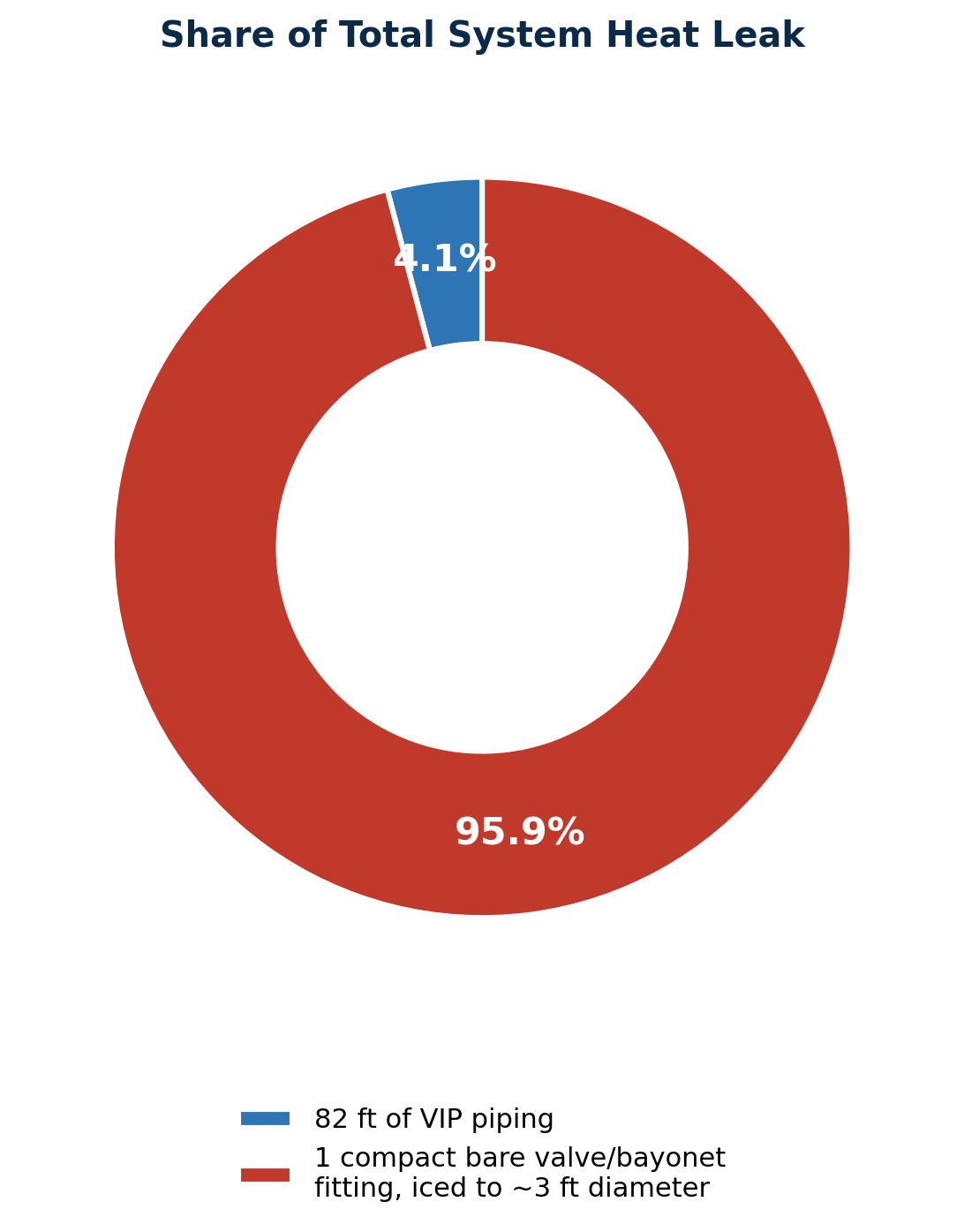
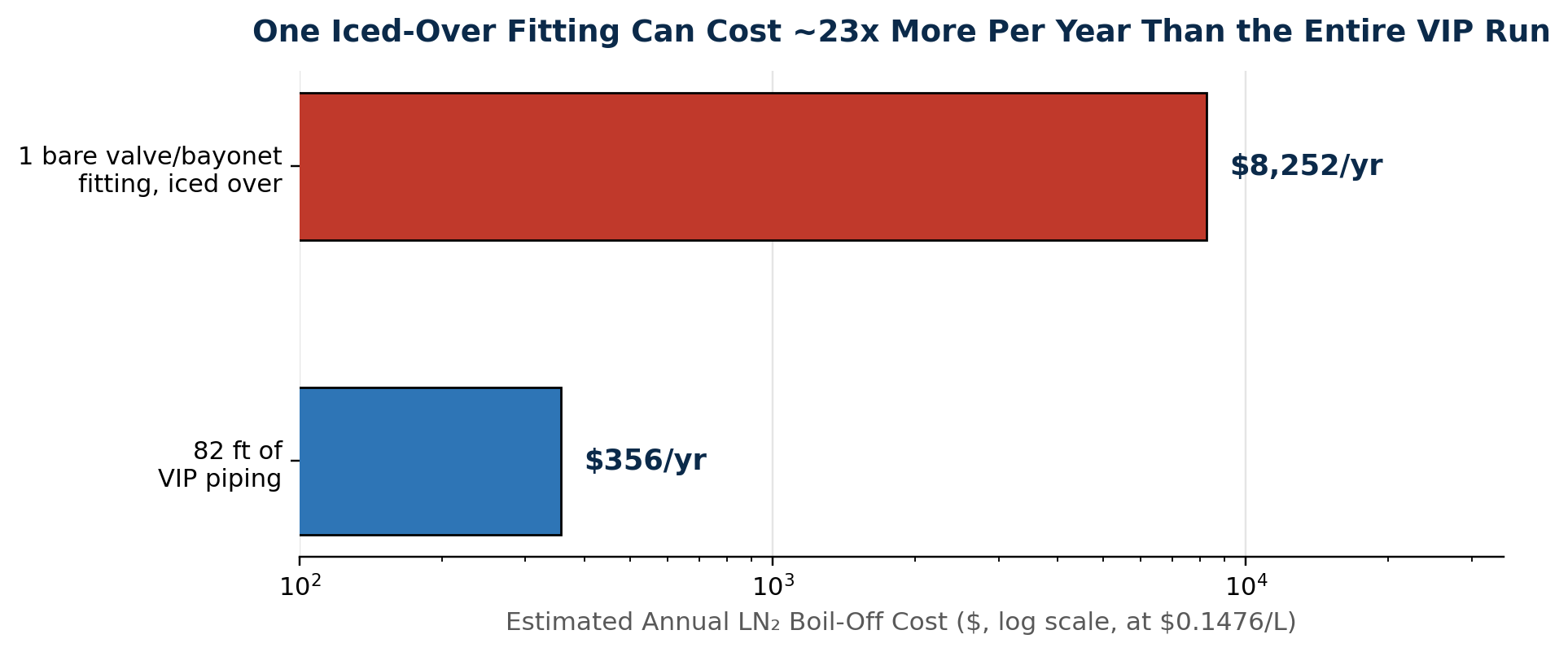
Worked example: 82 ft of VIP main run vs. one bare valve/bayonet fitting iced to ~3 ft diameter at the tank outlet, at a representative LN₂ price of $0.1476/L. Figures are representative estimates and will vary with fitting size, ice density, local air movement, and LN₂ pricing — CryoCraft Systems can build a project-specific version of this analysis for your facility.
Why It’s Easy to Miss
The withdrawal connection sits upstream of everything else in the system — any heat leak there is paid for before the liquid even reaches the VIP run. It’s frequently overlooked because it’s supplied as part of the tank package rather than specified as part of the piping run. Ask your CryoCraft Systems representative about our companion technical paper on vacuum insulated liquid withdrawal assemblies at the source.
CryoCraft Systems’ guidance
- Use Vacuum Insulated Pipe for any run feeding critical equipment, any run longer than a few feet, any outdoor or weather-exposed routing, and any application where product loss, safety, or long-term reliability is a priority.
- Weigh foam’s lower first cost against its rising heat leak and brazed-joint fatigue/leak risk over the system’s service life — the foam-vs-VIP comparison is never as close in year ten as it looks in year one.
- Foam-insulated pipe is an excellent choice for temporary or short-duration installations — test setups, seasonal campaigns, construction-phase or rental service — where the run will be removed long before age-related degradation matters.
- Don’t overlook the bulk tank withdrawal connection. It is frequently the single largest, and most overlooked, source of heat leak in the entire system.
- The economics shift for systems that run intermittently or on a shift basis rather than continuously — small leaks at joints and connections keep losing product during idle time, with no flow to draw attention to it.
Get a project-specific heat leak analysis
CryoCraft Systems designs, fabricates, and tests vacuum insulated piping, bayonet connectors, and flexible transfer hoses built to hold their performance for the life of the system.